Religion
Tetbury > Life
RELIGION
Catholic
Catholicism was the form of Christian tradition in England until Henry VIII fell out with the Pope. From that point on a turbulent history began for any professing the Roman Catholic way as the true way. Until the Catholic Emancipation Act of 1829 in it was illegal to be a Roman Catholic although many had continued to practice their faith resulting in confiscation of land and property and much persecution. Even after the Act Roman Catholics were not able to sit university exams or hold office in one. For this reason there will be virtually no records of any buildings or people connected to Roman Catholicism, in the conventional manner of registers and minutes of meetings.
It was thought that there was no Catholic tradition in Tetbury but research undertaken by Father Breen, the Archivist of the Fransalians, makes reference to a notebook of Father Larive who lists his Tetbury parishioners and the work being done in the town.
A report in The Tablet dated 20th August 1881 noted that Mass was held in the town on Sundays and holydays where before there had been little religious guidance and instruction. There was also mention of the silk and ribbon factories at Malmesbury, Tetbury and Sherstone owned by a Catholic proprietor and Christian employer, Mr Davenport. He apparently provided work for many juvenile employees, both male and female in all seasons.
The return of any form of Roman Catholic worship in Tetbury didn't happen until 1935 when the Salesians based at Malmesbury opened a branch house, with a chapel, at a house in Silver Street
The following year the church was registered for solemnising marriages.
1930
'Commodious premises' in Silver Street, known as York House were bought by the RC Authorities with a view to establishing a church in the town, although it was expected that the scheme would take some time. York House had previously been used as a private school
Western Daily Press 19/6/1930 p.7
Anglican
St Mary the Virgin and St Mary Magdalen
1363 Jun 30th licence for 20 marks paid to the king by Walter Walter of Tetbury, John of Weston, Ralph Hayle and John of Caldebourn of Tetbury for the alienation in mortmain by them of 24 messuages and 60 acres of land in Tettebury to a chaplain to celebrate divine service daily in the parish church of tettebury at the altar of St Mary for the good estate of the king and Queen Philippa for their souls when they shall have departed this life and for the souls of Peter of Brewys, Agnes his wife and Thomas their son. [Calendar Patent Rolls Edw.iii v.12 1.377]
1543 Vicar William Gore als Wotton died
1543 Vicar William Potter
1548 Vicar Thomas Powell
1551 Vicar Thomas Bolt
1556 Vicar Humphrey Horton
1563 Walter Romney and Thomas Mercer, churchwardens, and parishioners William Rumney, Richard Noris, John Savage present [to the Bishops Court] that the vicar had two benefices - Tetbury and Rancombe [Rendcombe?] nevertheless they say that they have divine service at due tyme. Those that had not received communion these months were Robert Grene, Thomas Horte, Edward Perstowe, John Howlane who also doesn't attend church, Robert Goosmore, Hughe Mowson, John Longston, Agnes Allen, Elizabeth Dibbull, Edward Harvey and Thomas Peerse. Edward Harvey was also a common drunkard. The Vicar had not preached against the usurped power of the bishop of Rome in his open sermons.
1577 Vicar Edward Norris
1578 Edward Norrys clerk compounded for the first fruits of the vicarage at Tetbury
1583 Vicar Henry Walmsley
1614 Vicar William Edwards
1661 Vicar Daniel Norris
1687 John Blisse clerk to be insituted to the vicarage of Tetbury vacant on the death of Daniel Norris
1712 Vicar William Scammell
1727 Vicar Ralph Willet
1728 Vicar Miles Gastrel
1739 Vicar John Turner
1742 Vicar John Wight
1778 Vicar Thomas Croome Wickes
1786 Vicar John Richards
1792 Vicar Richard Davies
1807 by his will Mr Thomas Alexander, schoolmaster of Tetbury, bequeathed his property to various charities, among which he ordered a bible to be given to every couple that was married at Tetbury church. [3/1/1807 Staffordshire Advertiser p.4]
1825 Vicar Samuel Paul Paul
1828 Vicar John Frampton
1881 Vicar Thomas George Horwood
1885 The Altar Cross, Candlesticks and Vases had been removed without permission and had to be restored to their former positions, which was complied with by Rev. Horwood.
1901 Vicar William Thomson
The Parish Church website
Monumental Inscriptions can also be searched from the parish church website
The current cockerel displayed on the left, and the former with a plaque on the right. The plaque reads 'The original weathervane cockerel mast and cross which was removed in 1893 when the spire was rebuilt. The cockerel is the symbol of Peter's betrayal.'
left: c.1777 or earlier
middle: c.1910
right: c.2008
St Saviour
St Saviours was built in 1848 and designed by Samuel Whitfield Daukes (1811-1880), who also designed the Royal Agricultural College, Cirencester.
It was originally intended as a little church for the poor, and was built on the instigation of Father Charles Lowder, the high church curate who later became known and respected as vicar in the East London Docks. Funding was provided by a charity fund and grants from Church societies.
The design is of a High Church style, with Tractarian Screen, long chancel and an altar raised on many steps with a reredos by Pugin. The glass is by O'Connor, there is a built-in pulpit and pews with poppy heads.
On Wednesday 23rd August 1848 the church was consecrated by the Bishop and other clerical dignitaries from the diocese. The Rev.Frampton preached the sermon at the morning service and the incumbent of Cirencester, the Rev. W.F.Powell preached in the evening. Both services were fully attended. After the service about 160 guests consisting of the bishop, clergy, parishioners, neighbouring gentry were entertained by the vicar. The children from the schools, numbered nearly 300, had tea and buns and workmen and others connected with the building had a supper in the evening. A full report can be read in the Bath Chronicle and Weekly Gazette 31/8/1848 p.3 which also gives a very descriptive account of the newly built church.
On 8th October 1914 a new portion of the burial ground was formally consecrated by the Bishop - the service was described as a most interesting and impressive one by the reporter, in the Gloucestershire Chronicle 10/10/1914 p.7.
The church is now redundant, however if you find it open it is well worth visiting for the lovely architectural features still on show. There is a particularly fine light in the centre of the building.
[taken from Country Life 13 December 1973]
Nonconformist
Nonconformist: meeting house licenses were granted by the County Quarter Sessions and gave permission for a group of worshippers to meet outside of the Church of England. These entries below were recorded in the Hockaday Abstracts at Gloucestershire Archives and are the entries from the Bishops administration records indicating the granting of licenses for meeting places.
1758 a certificate that the dissenting subjects called congregational intended to hold a meeting at a house of Edward Brown and late in the occupation of the Rev. Mr. David Edwards situated on The Green
1765 a certificate that the dissenting subjects called independents intend to hold a meeting in the dwelling house of Cove Lloyd, woolstapler being in a street called Gloucester Street
1766 a certificate presented by the dissenting denomination for a dwelling house belonging to Thomas Barrow, a woolcomber, on the Green; also the house of Joseph Ayre, gentleman on Gumstool Street; also at a meeting house situate and standing at the bottom of a hill near Chipping Croft
1777 a certificate presented by the dissenting subjects called baptist denomination in house erected for religious worship in a court on Church Street, signed by Joseph Burchell, Thomas West, Thomas Wear, Nathaniel Overbury, William Overbury and John Overbury
1779 a certificate presented by the independents for meeting in the house of Martin Lloyd
1780 a certificate presented by the independents for meeting in a house lately occupied by John Giles
1816 a certificate presented to the Bishop of Gloucester by Martin Lloyd, woolcomber, Jeremiah Grant, Milburn Crew, Thomas Phillips and William Keynton that a tenement being part of a building in Long Street, now in occupation of Thomas Young to be used by protestant dissenters.
1823 a certificate presented to the Bishop of Gloucester for a house and premises adjoining the premises of Samuel Lamb in the joint occupation of Samuel Lamb and John Bigland to be used by the tent methodists
1826 a certificate presented to the Bishop of Gloucester for a house and premises in Cirencester Street by Thomas Ashton, minister, Wm Dyke, Thomas Trotman, Edward Turrell, all of Tetbury, to be used as a place of religious worship by protestant dissenters
1844 a local branch of the Latter Day Saints [or Mormons] was meeting in Harper Street, with about 43 local members, some of whom will have emigrated to Utah. The meetings ended in 1898.
1851 religious census taken on 30th March listed the following congregations meeting in the Tetbury Union [therefore not just the town but villages comprising the poor law union]. A full report of this census was published in 1854 and can be either read online.
KEY TO TABLE BELOW:
A number of places of worship
B number of sittings - free
C number of sittings - appropriated
D number attending morning worship
E number attending afternoon worship
F number attending evening worship
DENOMINATION | A | B | C | D | E | F |
Church of England | 15 | 1220 | 1509 | 1905 | 893 | 646 |
Independent | 1 | 80 | 160 | 144 | 114 | 130 |
Society of Friends | 0 | 0 | 0 | 0 | 0 | 0 |
Unitarians | 0 | 0 | 0 | 0 | 0 | 0 |
Wesleyans | 1 | 50 | 90 | 0 | 28 | 29 |
undefined | 2 | 406 | 54 | 73 | 93 | 230 |
Roman Catholic | 0 | 0 | 0 | 0 | 0 | 0 |
Latter Day Saints | 1 | 70 | 0 | 17 | 42 | 55 |
Baptist
The Particular Baptist Church, which it is thought was formed in 1721, has occupied the site on Church Street since at least 1764. In 1725 a newly built house in Tetbury was registered for Baptist use. In the 1735 religious census 38 people were meeting regularly. In 1799 between 40-50 members met in a 'neat chapel which lay in a retired court in the centre of the town and was entered by a gateway.' The building was built principally at the expense of the Overbury family, whose progenitor, Mr John Overbury, was for many years pastor of the place. Over 200 were meeting in the religious census of 1851 but by the 1970s the congregation tended to number no more than 12.
The Rev. Jonas James Kiddle was called to the pastorate in 1858 and on Good Friday was in place as the new pastor. The General Baptist Repository and Missionary Observer Vol V 1858 has the following report [abridged]:
‘On Good Friday Mr E.H.Burton visited Tetbury Chapel and Dr Thomas, president of Pontypool College along with about a dozen other ministers present on the occasion of the re opening of the chapel and in recognition and the settlement of the new pastor. The weather was rain and sleet but the chapel was filled to overflowing. The evening in particular was very crowded. More persons were outside than inside and had to go away.’
In the boundary of the Church Street property are two confronting buildings, being the present chapel and an earlier building thought to have been its predecessor. The earliest building was built of rubble with a stone slate roof, with two gables at the front, in each of which there is a small attic window. Below these, larger windows have been inserted, comprising round arched heads of bricks and keystones. The doorway is of a similar date and style, and is positioned between the two windows. The present chapel, built of stone with a hipped stone slate roof is thought to be as late as 1800. The frontage has two doorways and three upper windows, again round-arched but with stone heads and keystones. The interior has an L shaped gallery.
Strict Baptists or Calvanists were established in the town by the 1860s and built a chapel on The Green in 1871/72. When this sect disbanded in the 1940s the chapel was eventually used by the Roman Catholics.
"There are a few more details of the work at Tetbury although it is a matter for profound grief that the beautiful little chapel erected in 1872 should now be a RC church. From 1852 meetings were held in various rooms in the town until in 1857 a chapel was erected near the national schools and was opened by Messrs Mortimer, Tanner and Beard. What happened to this chapel is not clear but in 1865 when Mr Farvis went among the people they seem to have been meeting elsewhere. A second chapel was opened for them in 1872 by a B Taylor of Manchester and Forster of Witham. Mr Farvis was pastor until 1877. By 1942 the chapel had been closed and sold by order of the charity commissioners." [extract from Strict Baptist chapels of England – Wiltshire and the west; Oliver, Robert W 1968]
| 1751 | Nathaniel Overbury |
| 1810 | J.Burchell |
| 1810 | At a meeting held in May 1810 it was agreed to pay Mr Godwin of Tetbury for his work around the villages surrounding the town Mr Millard was to be allowed financial assistance for similar works too. |
| 1816 | Rev Joseph Burchell [died 17 July 1826] - his grandson Thomas was baptised by immersion on 28 November 1816 with eight others. A note in the members book of Horsley Baptist circuit records that he went as a missionary to Jamaica in 1823. |
| 1828-1844 | J O Mitchell |
| 1851 | George Davies |
| 1851-1861 | Rev J.J. Kiddle |
| 1861 | Charles W Vernon |
| 1861 | George Morgan, father of Campbell Morgan who was born at Cutwell Villa |
| 1862 | Rev Thomas Jones |
| 1865 | John B Brasted - a report in the Baptist Magazine for the year remarked on the settlement in February with a service led by Rev.T.Page (Independent church). Mr Cavil, Mr Peglar, senior deacon Mr Mapson and Rev.Brown of Cirencester led the proceedings. Attendance was 'large and gratifying'. |
| 1871 | Thomas Williams |
| 1881-1892 | Rev Robert Bray |
| 1895 | Rev T Napolean Smith |
| 1901 | Thomas Brain |
| 1924 | L Jenkins |
| 1955 | Rev N Trussler |
Sources:
Gloucestershire Archives hold a microfilm of the Accounts etc of the Horsley Baptist Circuit - check the nonconformist records catalogue [finding aids] for full reference.
Inventory of Nonconformist Chapels and Meeting Houses in Central England: Gloucestershire ISBN 0113000081
VCH: Gloucestershire Vol.11 – available online at www.british-history.ac.uk
Images of England: www.imagesofengland.org.uk
Baptist church history
Strict Baptist Chapels of England: Wiltshire and the West; Oliver, Robert W 1968
Baptist church magazines available through Google Books
Presbyterian
Around 1705 the Presbyterians built a chapel at the bottom of the Chipping Steps. Rev. Thomas Jones 1675-1745 may have built this at his own expense. By 1861 the church owned the cottage next door (37 Chipping Steps) which was used as a Manse. In 1953 it was listed as a building of special interest and sold in 1959 for £100.
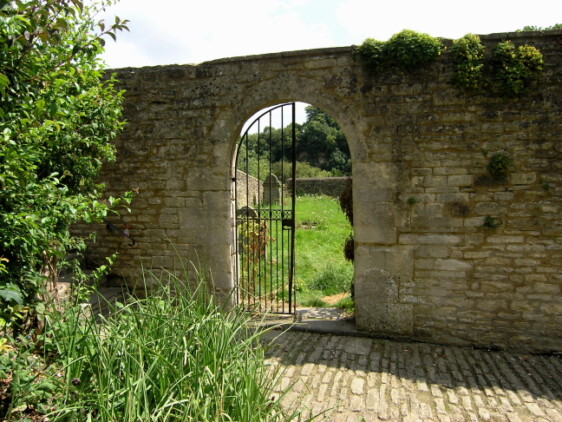
The chapel was demolished but their burial ground remains.
Many of the stones are damaged and therefore without paper records it is impossible to work our who some of the memorial stones are commemorating. One of the more elaborate graves has a mason’s signature on the side: a Cirencester mason by the name of Newcombe.
Daniel Vanstone
In loving memory of Daniel Vanstone
Who died March 17 1860
Aged 64yrs
Faint inscription
Also Elizabeth
Who died ? 1878?
Faint inscription at bottom to another Daniel Vanstone?
In loving memory of Mother
Widow of William Cull
Who died 25th July 1907
Aged 77
Also of
Francis Cull
Son of the above
Who died April 9th 1924
Aged 59yrs
Also of Albert Thomas Cull
Son of the above
Who died Sept 8th 1926
Rev William Henry Dash
died April 9 1932 aged 76 years
Congregational Church
In the reign of King Charles II there is a reference in Domestic State papers for 1672, an entry licensing Jonathon Smith of Tedbery, to use his house as a place of worship. A reference in the Parish Registers between 1822-37 mentions a church formed in 1698. For other licences issued see here.
Jonathon Smith was one of the 2000 clergy to be ejected from their living by the state for not signing up to the Act of Uniformity – his was Hempstead, GLS but the 1802 publication “The Non-Conformist’s Memorial” by Edmund Calamy and Samuel Palmer makes no mention of his time in Tetbury, it just states that he [Jonathon Smith jun.] taught at Ross [on Wye, HEF]. Note the addition of ‘jun’ that appears in the ancient book, which is a reprint of a publication from over a century earlier.
The Presbyterian Building - see also Chipping Steps Burial ground
A memorial plaque on the wall of a church in Llandrindod Wells pays tribute to the Rev Thomas Jones of Tetbury, who founded the church in Llandrindod following a 30 year term of service in Tetbury where he built a church at his own expense. He died in 1745 at the age of 70.
There is not much information following Rev Jones period of ministry apart from reference to some thorough repairs and a reopening service in 1805.
In January 1857 Thomas Page of Hanham was invited to occupy the pulpit on probation for the month, and on 5 February a letter was sent inviting him to become the new pastor. He conducted his first meeting on 27 March 1857 and preached from Romans 15 v.30.
Land in The Chipping was purchased by the church for £160, from Henry Witchell. The foundation stone was laid on 23 May 1861. After the buildings completion the old chapel at the bottom of Chipping Steps became a burial ground for the Congregationalists from 1864-1945. A note in the chapel’s register indicates that the new building opened on 2 September 1862.
On 10 March 1901 a fire in the gallery during morning worship was quickly dealt with by the Tetbury fire brigade. The then minister, Rev. Spry managed to hold the fire at bay by pouring cold water on the flames until the fire brigade arrived. Part of the gallery was removed as it was now unsafe.
In 1992 The Tetbury Congregationalists (or United Reformed Church, as the congregational movement joined with the URC nationally in 1972) and Methodists joined together to make the church known today as Christ Church.
A noteable work, written by Robert Smith, ‘Gathered Together - the history of nonconformity in Tetbury’ is worth getting if you can get hold of a copy. Originally sold to raise funds for the Christchurch Development Appeal.
Chipping Steps Building: | |
Jonathon Smith | |
| c1710-1740 | Rev Thomas Jones |
| 1805 | Rev Davis |
| 1821-1846 | Rev James Gough 1821-1856 - Polling list of 1830s lists him as ‘minister of independent chapel, entitled to annual rent of 40s, issuing out of freehold house’ tenant was William Lamb. |
At the Congregational Church building on The Chipping: | |
March 1857-1867 | Thomas Page 1859 directory lists Rev T. Page, Cotwells. 1863 directory lists Rev T. Page The Chipping |
| 1868-1873 | George Slatter |
| 1874-1877 | Rev James Grosvenor |
| 1879-1889 | Rev T. Wesley Brown |
| 1890-1897 | Rev Pearson Cooper |
| 1897-1901 | Rev Elijah Spry |
| 1902-1931 | Rev W.H. Dash |
| 1931-1935 | Rev Richard Ball |
| 1940-1943 | Rev T.D. Watkins |
| 1942-1944 | Mr J.B.Gotts honorary pastor |
| 1944-1945 | Rev James Vaughan |
| 1948-1951 | Rev John H. Collins |
| 1952-1957 | Rev T.Howard Owen |
| 1963-1967 | Rev R.A.Crew |
| 1971-1990 | Rev D.H.Parry Jones |
Open Brethren
The Gospel Hall was the meeting place of the Open Brethren, which was built in 1949 to replace meeting rooms in Long Street.
The congregation of Open Brethren was established by 1897 and the group large enough to consider renting an old woolcombing room behind 55 Long Street. They converted the room to house pews and a small baptistry. Around this period a well known Christian author, Dr Campbell Morgan was residing at Cutwell Villa and he became the leader. The building was purchased during the Second World War with the intention of altering it to make it more suitable for it's intended use. However major work was found to be needed. An alternative was needed and after prayer meetings Hilda Cleaver and a friend felt led to a plot of ground near the current chapel. A new building was erected by Reg Cox, a local builder, with Eddie Long. The building was opened officially on 3 December 1949. A prayer meeting on the 12 November saw the building opened to the congregation and a agreement was made between the committee of management: Ralph Cleaver, Edmund Jesse Houghton, Stephen Henry Collis Parslow & Frederick George Pitman, and a number representative of the assembly: Henry Wittern, David Hacker, Vivian Topps & Richard Peyton.
[source: documents held by the late Mr R Wakefield]
'Gathered Together' the History of Nonconformist Worship in Tetbury, by Robert Smith. 1998]
Plymouth Brethren were established in Tetbury by 1856, meeting in a room at the site of the Old Post office, Chipping Street. From here they moved to a room off Gumstool Hill, but took the opportunity of moving to the old Methodist building on Bath Bridge in 1908. In 1992 a new church hall was built at the point of Northfield Road where Love Lane joins. This building had no windows, in keeping with the belief of the Brethren but was only in use for just under four years.
Methodist
1827 the Wesleyan Methodists had built a chapel on Gumstool Hill, to the rear of the workhouse.
1838 saw a mission in Tetbury – Mr Preston and Mr Excell would go out to Tetbury and the country around, commencing on April 8. By the next quarter Tetbury appeared on the Tetbury Mission Plan along with other neighbouring villages.
1840 In February 1840 the Tetbury Mission joined with Cirencester Mission to become the Tetbury and Cirencester Branch. Sadly after just two years the Tetbury congregation seemed to have disappeared.
1858 In 1858 the Brinkworth Circuit held a Revival Meeting held in Tetbury on 7 March. J Dixon [Brinkworth], J Rumming [Grittenham], G Broom & H Wicks [Hullavington] were the leaders of the event. There were weekly meetings on Sunday at 2.00pm and 5.30pm, and during the week on a Thursday evening at 6.30.
1859 The Malmesbury Circuit was formed in January 1859 and Tetbury became a part of this.
1871 The Primitive Methodists built a chapel on Union Street, which was in the location now occupied by Chantry Court. An announcement in the Royal Cornwall Gazette 1st April 1871 announced the opening of a new Primitive Methodist Chapel, part of the Malmesbury Circuit, the building and site had cost £320.
1887 With help from the nearby Malmesbury Circuit the Wesleyans moved to a larger building near Bath Bridge. The first service was on 17 April 1887, and they worshipped here until 1909.
1909 On 24 June 1909 a chapel on Long Street was opened by the Wesleyan Methodists. Mr W S Jenkins, a local builder built the chapel from Cotswold stone on the site of three cottages. Henry Smith was a trustee, and he also roofed the building. Other trustees were W G Banks, J Prescott and J Young. The church thrived for many years.
1992 In 1992 they joined with the URC to form Christ Church. The building was sold for £68,000, after 170 years of worship in Tetbury.
Salvation Army
The Salvation Army set up a branch in Tetbury in 1884. Some of the ‘soldiers’ listed in the War Cry of 1885 were William Bignell, an agricultural labourer from Harper Street, Mrs Cooley, wife of Isaac, ‘brother’ Fisher [either William or Frederick] who ran an outfitters on Church Street, Mrs Millard, wife of Aaron, and John Smith, a labourer aged 22. A false charge of rape was aimed at William Smith, but he was found not guilty, and complained the charges were levied against him because he belonged to the Army.
The Salvation Army hall was located initially in The Chipping. By 1890 they were no longer in the town but returned in the 1920s, to a hut located at the junction of Cottons Lane and West [Harper] Street.
1883
A visiting detachment with small brass band, from the Sherston branch paraded to Tetbury on 24th November 1883 and held an open air meeting on The Chipping after parading around the street. They received some verbal abuse from residents which resulted in a hearing at the town Petty Sessions. Isaac Cooley was called as a witness but insufficient evidence led to the case being dismissed.
1884
Another member, James Hayes was assaulted whilst at a meeting on The Chipping in February 1884. In March Ellen Cooley was assaulted by her neighbour following a dispute over the Army. Later in the year more cases appeared in front of the Petty Sessions - James Nurdin obstructing the highway on Market Place in connection with the Army; fighting between two men, one of whom was a member of the Army (William Cox).
1925
Captain Wick of Highbridge, Somerset was removing to Tetbury -was this to take charge of the SA in the town?
Cheltenham Chronicle 21/3/1925 reported on the efforts of the Cirencester and Tetbury Corps of the Salvation Army who, through self denial, had raised £128+ - their target was £84.
In June several members of the Tetbury Corps attended at lecture and tea at Cirencester.
1926
Cheltenham Chronicle 10/4/1926 p.15 a report on the opening of Tetbury's New Salvation Hall:
Formal Opening Ceremony
The recently formed Tetbury Corps of the Salvation Army has been successful in building a new hall for its indoor services. The building, which will seat about 130, is situate in West Street and during Easter it was formally opened by Mr Percy Pelly (The Priory) who was supported by Major G.Lowsley-Williams, Mr H.G.Harris (Chairman do the Urban Council) etc. Special services were held during the weekend and on Monday, the Bath Young People's Band being present throughout.
In July a fundraising effort towards the hall aimed to raise £100 by a sale of work held over two days.
1927
A prize giving for the Sunday School in January 1927 reported that the number had grown to 70 scholars in a very short time.
1929
Captain Skinner led the Christmas service at the Baptist chapel.
1933
May - announced that Captain Robinson, who had been in charge of the Tetbury corps for sometime was to take charge at Keynsham. He had married Capt. Edith Whiteman at the congregational church in the town and a banquet was held at the army hall.
July - children of the corps went by motor coach to Weston super Mare
1934
30 people were entertained to dinner at the Salvation Army Hall on Boxing Day 1933. a programme of Salvation Army gramophone records was given. Captain Kirkwood, the commanding officer, with other members of local corps and friends had charge of the catering
Wilts & Glos Standard 6/1/1934
1940
Capt Peek of Tetbury to take charge of a corp in Shepton Mallet, Somerset