Buildings
Tetbury > Places
BUILDINGS
Almshouse
According to Lee “at the present time [1857] eight poor women reside in the Alms House; each having a room rent free and receiving about 30s a year from different benefactions left for that purpose. When a vacancy occurs the Feoffees fill it up.”
However, the almshouses were in existence for at least two centuries before this. For more information read the extract from the Victoria County History.
By 1919 the sum received was about £2 2s 8d per year per woman plus entitlement to claim relief under a bequest of Dr Richard Filkin. Monies left for the benefit of the Almshouse charities include £50 left by Esther Clark 1774; £20 by Eleanor Ludlow 1804; £20 by Sarah Ludlow 1816
Known residents:
Baldwin 1841; Bamford 1841; Dicks 1871, 1881; Golding 1871, 1881; Hambridge 1841; Harris 1851, 1861; Lock 1861; Screen 1861, 1871; Tugwell 1901; Whitehead 1861; Winterson 1851, 1861; Witts 1871;
Market and Town Hall
The first market in Tetbury was on The Chipping, (also known as Chipping Croft), and then in the C16th moved to it's present position. It was recorded as early as 1287, and held by William de Breuse, who was able to claim the market from time immemorial, probably c.1200, at the creation of the borough. In the mid sixteenth century it was held on a Wednesday.
The fair on the 22nd July (the feast of Mary Magdalen) was first recorded on 23rd June 1350, and was held by Thomas de Breuse, who had been allowed to extend it to seven days. This fair was recorded until the mid sixteenth century, and continued until at least two hundred years later.
By 1594 the new market place was on the site of the White Hart, which was the chief inn in the town at this time. It was the point where the two main roads of the town crossed. By 1655 a market house and town hall building became the focus of town life.
The Ash Wednesday fair was recorded from at least the mid sixteenth century up until the mid eighteenth century. Fairs were held on The Chipping.
Atkyns in his book 'The ancient and present state of Gloucestershire' states "there is a large handsome market-house in the midst of the town, for the use of the yarn trade, and a lesser market-house for cheese and other commodities. There is a very considerable weekly market on Wednesday, which chiefly consists of yarn. Their fairs are on Ash-Wednesday, and on the twenty-second of July."
A plaque on the wall of the current market house tells us that “this great market house was built in 1665 and replaced an earlier building.” Major reconstruction took place in 1740 and 1795.
The illuminated clock was installed to mark Queen Victoria's golden jubilee in 1887.
At the east end of the market place, in the entrance to Cirencester Street was a lesser market house. This was built for the sale of cheese and bacon, which used to be sold in a penthouse off the Talbot Inn (1656). By the late C18th it had fallen into disrepair and was demolished in 1816. The prosperity of the market in the town was assured by the fact that the town was a major through route, but the main influence was the situation the town held in a rich wool growing area.
In 1221 there were two wine merchants trading, and by the mid thirteenth century it was well established as a market for agricultural produce. Tolls from the market and fairs produced the princely sum of £11 10s in 1296. The fair was a recognised mart for wool by 1306. By 1381 it was established as a centre for the sale of wool from the surrounding area. The market became one of the best in the region bringing in tolls of over £120 per year in 1622. The wool and yarn market thrived into the C18th, and by 1730 the market house was bursting at the seams. On one occasion the Thirteen had to seek another meeting place. Cheese and bacon rivalled the wool market drawing in producers from North Wiltshire and the Vale of Gloucester.
During the C18th market trade began a decline to such a point that by 1811 the market tolls only amounted to £14. A great market for cattle was established in 1810 and was held on the second Wednesday of every month. This was toll free, and dealt in cattle, sheep and horses. An additional livestock fair was begun in 1834, and held in November. In 1888 a new cattle market was opened by the railway, and was in use until 1974. By 1904 the market trade had declined so much that it was thought it might be abolished, but there was a revival in the 1920s.
The corn market was held at the White Hart from the early C18th, moving to the Town Hall in 1884. It had lapsed by 1900, was revived for a short time before the Second World War on its former site, the White Hart.
Administration of the markets has been from the Feoffees, running them on behalf of the townspeople, and from c.1900-1936, the Urban District council leased the tolls from the Feoffees.
The Market building is probably built on the site of another building called the Tolsey. It was erected in 1655 with an open colonnaded ground floor, and the upper story approached by stone steps, which served as town hall and meeting place of the manor court. Reroofing took place in 1740, along with an extension to the south west. Gables were removed from the roof in 1817.
Others uses of the building include Orchestral Concerts - on Weds 24th April 1850 'Messieurs Richardson and Sons last musical tour' in England before visiting America and Canada were to perform at the Town Hall as part of the tour. The programme included operas and works by Handel, Rossini, Mozart and others as had been perfomed in front of the Queen a few years before. Tickets cost 2s or 1s for children/schools and perfomances were held matinee and evening. An advert appears in the Gloucester Journal - Saturday 13 April 1850 page 2. Public meetings held included those for the proposed railway in 1872. In 1886 an enquiry into the Tetbury Charities was held which attracted 100 attendees. Political meetings, Annual General Meetings, fund raisers, antique fairs and similar have all been held there and will continue for many years to come.
Farms
Broadfield Farm
Broadfield Farm is situated midway between Colly Farm to the north and Highfield Farm to the south.
It was farmed by the Titchcomb family in-between 1851 and 1871. In 1860 the property was owned by R. Holford and occupied by John. [source: Tetbury Poor Rates; P328a OV1/32]
John came from Oxfordshire, and his wife, Mary, from Tetbury.
In 1851 John was farming 106 acres with the help of one live in servant, David Hassell, 19 years old from Quenington, GLS. There was a live in female servant, 18 year old Ann Lewis, from Poole, GLS.
In 1861 his two grandsons, William and Edward were living there, with two servants - Ann Hawker was the general servant, and Thomas Ayres, the farm servant. John was farming 68 acres and employing just one man.
In 1871 the farm size had reduced to 60 acres and John was employing one man.
John died in 1873 aged 79 and Mary in 1875 aged 74.
By 1881 Solomon Rawlins was farming the land, which was now listed as 65 acres. He was living there with his wife Mary and two sons, George and William. William was born in Tetbury, which would indicate that the family moved into the parish c1865. Solomon died in 1896 aged 62. After his death George and William continued to farm the land until at least 1911. This census lists the farmhouse as having eight rooms.
1910 Broadfield Farm still under the tenancy of the Rawling brothers was farming on 64 acres and the owner was ? who had part purchased the property in February 1909. The occupiers tenancy was on an annual term at 110 per annum, the contract started in March 1909. The farmhouse was of stone and stone tile construction in fair repair. On the ground floor was a sitting room, kitchen, back kitchen, dairy and pantry. On the first floor were three bedrooms, and on the second two attics. Gross value was 2332,
Farm buildings comprised stone and tile four bay feeding shed; stone and corrugated iron cattle shed; two bulls houses; stone and stone tile five bay open fronted shelter with loose box at end; stone and stone tile stabling with tie up for four with loft over; stone and corrugated iron cartshed; milking yard; two old stone and stone tile pigsties with coal house adjoining. Fences are quarter hedges, and quarter stone walls. Water supply was not good, and there was no timber, only a few odd sticks for shade. The orchard was classed as poor.
By 1985 Broadfield Farm was part of the Duchy Home Farm.
The following item was extracted from a web site page [http://www.efrc.com] but is no longer online.
"Duchy Home Farm has been established since 1985 and comprises three blocks of land around Tetbury. David Wilson (Farm Manager) has been responsible for the conversion to organic farming which started in 1985. Initial costs of the conversion were high as the previously arable parts of the farm had no fencing or water supply for stock. The dairy was converted by 1993, yields have improved and economic performance has been acceptable, even when premium prices were not available. The sheep flock was converted by 1991.
Duchy Home Farm consists of separate land blocks Broadfield Farm to the northeast of Tetbury, land at Doughton to the southwest, and a Westonbirt parcel. The first land was bought in 1980 with Broadfield Farm added in 1985 to form the home farm for Highgrove. Agronomic and environmental research is carried out on the farm by several universities and research institutes, and demonstration work has been expanded to promote understanding of food, farming, wildlife and health links."
RESOURCES:
BROADFIELD
FILE [no title] - ref. D131/T21 - date: 1651-1810
[from Scope and Content] Includes copy abstract of title of John Lawrence to the property (1681-1772); and of John Hinton, (1682-1809); settlement before marriage of Nathaniel Adams of Avening, clothier, and Mary, daughter of John Taylor of Broadfield, in the parish of Tetbury, gent., 1719; will of Edward Adams of Avening, clothier, 1701, proved 1701
Close Farm
Close Farm was owned by Col E F Morrison Bell in 1941. He estimated that the rental value of the farm was £300 per annum, and had held the farm of 20 years. The farm is located midway between Tetbury and Doughton on the Bath Road.
On a farm survey carried out on behalf of the Ministry of Agriculture on 17 May 1942 it was described as follows:
With no farm house, two cottages, one of which was let on service tenancy. There were farm buildings, a well and stream and ponds which supplied water. Problems were caused by moles, insects, dandylions and buttercups.
It was reported to be a good mixed farm, but labour was seasonally short. At the time of the report there was none listed. Machinery was adequate except for a tractor which was on order. 'Motive power' was one oil/petrol engine of 2½ horsepower. There was a converted Ford lorry, and a wheel tractor for field work.
A strip of clay land crossed the farm, this land lies wet, but there was no serious flooding. There was no rough grazing land.
The following grass fields had been ploughed up (OS field no's) 700, 706, 740, 703, 736.
In 1941 they grew the following crops and had the livestock as listed:
14 acres wheat
7½ acres barley
10 acres oats
3½ acres main crop potatoes
1½ acres kale for fodder
50 acres grass for mowing
49½ acres for grazing
They had the following livestock:
CATTLE
8 cows
1 cow in calf
13 heifers in calf
1 bull
2 x 2 years+ male cattle for service
22 x 2 years+ female cattle for service
2 x 1 year+ male cattle
3 x 1 year+ female cattle
11 x under 1 year for rearing
TOTAL 63
PIGS
3 sows
2 x 2-5 months old
TOTAL 5
HORSES
2 x mares
2 x others
TOTAL 4
RESOURCES:
NATIONAL ARCHIVES: Ministry of Food: National Farm Survey, Individual Farm Records MAF 32/108/272-3
Colly Farm
Colly Farm was built in the C17th and formed part of the estate that the Savage family acquired. It is situated on the north side of the town, midway between Cherington and Tetbury, and was at the centre of the Savage's estate.
1841
two young ladies Sarah Fry and Harriet Lord were living at the farm with a servant, Ann Luckner and three agricultural labourers - William Fletcher, Henry Glastonbury and William Wall. It is not clear in the census what Sarah and Harriet’s roles were.
1841 Census
1848
around this date the Cave family moved from Newington Bagpath to take the farm.
[based on the birth place of children]
1851
George Cave farmer of 305 acres employing 10 labourers
1851 Census
1854-59
George Cave
trade directories
1860
occupier was George Cave, owner John Savage
Gloucestershire Archives ref.P328/1 poor rates
1861
George Cave, wife Eliza [nee Deane], daughter and two sons were living and working there. George was farming 335 acres, employing 5 men and 3 boys. The family was in occupation less than 16 years, and had left by 1868. They had one dairymaid, living in - Clemantine Cook.
1861 Census
1868
Mr Maggs of Colly Farm had a ram killed and several sheep worried and injured by some dogs
Wilts & Gloucestershire Standard 18th July 1868 p.5
1868-70
Joseph Emmanuel Maggs, by the census in 1871 he was living on Long Street with occupation recorded as ‘late farmer’. His mother, Ann, was at one time landlady of the Ormonds Head Inn. He died in 1878 and occupation was listed in his will as farmer.
census
National Probate Calendar
1870
November - auction sale by Moore and Hill on the instruction of Joseph Maggs who was leaving the farm, his stock of 70 short-horn cattle. 6 capital breed sows in farrow, 2 hilts in farrow, 1 fat pig, 3 porkers and a few sheep. The feed of 34 acres of swedes and 140 acres of grass keep and seeds. Lots of other wheat, grains etc, troughs, hurdles and sheep racks. Fields with the grass keep for sale near to Back Lane, Tetbury.
Wilts & Gloucestershire Standard 19th November 1870 p.1
1871
March – auction sale by Moore and Hill by the instruction of Joseph Maggs, the remaining part of his live and dead farming stock comprising of 33 cattle, 5 cart horses, nag pony, pigs and agricultural implements as new
newspaper
1871
at the time of the census it was unoccupied
1871 Census
1872
Edward Knight junior (executor of his father's will dated 1872)
1876
November - sale of freehold estate known as Colly Farm consisting of a homestead and buildings with several acres of arable land and pasture available as one lot or can be split; tenant Edward Knight available to show around
Wilts & Gloucestershire Standard 11th November 1876
Auction sale of Colly Farm following the death of Mr Edward Knight senior who was farming at Doughton
newspaper
1879-85
Edward Knight; by the time Edward married in 1887 he was resident in Horsley, then moved by 1891 to Seagry Heath Great Somerford, Wiltshire.
trade directories and census
1881
Edward Knight was farming 235 acres, with his sister (housekeeper) and brother (assistant)
1881 Census
1889
Edward Kellow Percy Wood from Cherington, son of the rector.
trade directory
1895
September - Colly Farm to be auctioned by Messers Moore and Hill as instructed by Edward Wood who was giving up the farm. 309 cross bred sheep, 10 prime steers, 7 carthorses and colts, and implements [listed as 2 harvest wagons, 2 dung carts, 3 single iron ploughs, iron drags, Cambridge rolls, corn and turnip drills, root pulpers, turnip cutters, various racks, hurdles and troughs, reaping and mowing machines, harnesses and so on, most of which were purchased within the last few years and in good working order]
newspaper
1896
C.F.Moore auctioneers to sell cattle and implements remaining from the earlier sale of Mr Wood’s stock.
newspaper
1897
Richard Hitchings
trade directory
1902-1910
William Bryant
trade directories
1910
occupied by L.C.Bryant, owned by Alfred Prout The annual rent was £160 with part of the property being situated in Avening. The gross value was £3676. The stone and stone tile farmhouse was in a rather poor condition and had the following accommodation - ground floor: hall, sitting room, dining room, dairy, kitchen, pantry, cellar, outside WC and coalhouse; first floor: three bedrooms, box room, large cheese room over dairy; second floor: two attics.
The water supply was poor, with the drinking water having to be fetched from Tetbury. Outside buildings were a stone and pantile four bay shelter with loose box, milking yard adjacent; granary with loft over - workshop; stone and stone tile mealhouse; five brick and tile pigsties with stone slab floor; stone and stone tile tie up for four with feeding trough; stone and stone tile eight bay shelter with bulls house and milking yard; stone and pantile fowlshouse and two boxes each tie up for two and feeding trough and traphouses adjoining; tie up cowshed for nine with stone floor and feeding trough; cowhouse for two; stone and stone tile shelter shed; large store and pantile barn with stone floor [double bay]; cowhouse in farm; stone and stone tile cartshed; stone and stone tile carthorse stable for six; loft over; stone and stone tile barn double bay earth floor.
Buildings were very plentiful; fences were mostly hedges, with a few stone walls.
Land valuation survey
1926
William Cave, late tenant of the farm died and buried at Cherington churchyard
newspaper
1934
Colly Farm sold by Jackson, Stops and Staff of Cirencester
newspaper
1939
Percy Cave was a dairy farmer [but not indicated as the head of household, who was a worker in the air ministry], William J.Lane was an assistant to farmer and household amounted to 10 people.
1939 register
1946
W.R.Preston of Ilsom
London Gazette
Folly Farm
The Folly was described as a Queen Anne building 'of considerable character and charm, of Cotswold stone with Cotswold stone tiled roof' on sale particulars in 1956. It was auctioned at The White Hart by Cheltenham auctioneers, Chamberlaine-Brothers & Edwards on 26th September 1956.
The sale was in two lots - the house and grounds comprising 2.75 acres and the second was stable blocks with living accomodation and grounds compirising just under 1.2 acres.
1859-1868 William Taylor
1874 Mrs Crew
1894-1902 George Butler
RESOURCES
GLS ARCHIVES
D1571/E1 c.1774, 1780-1783
1 vol.
Contents:
"Surveys and yearly Estimates of Sundry Estates being in Several Countys the property of Thomas Estcourt Esqr."
Gives field and tenants' names, acreages and valuation of: .. Folly Farm, in Long Newnton; ...
Includes terrier and quit rental, Tetbury...
D1571/E5 1894-1896
1 vol.
Contents:
"Field book" giving names of tenants and fields, rents, crops and acreages of: ... Folly Farm, in Long Newnton; ....Indexed by names of farms and tenants. Most accompanied by plan from O.S. 6" map
DA 36/710/2/50 14.10.1937
Additions/alterations to cottage, Folly Farm, Long Newnton (plans); owner: Sir Peter Grant-Lawson; builder: Holborow and Son
DA 36/710/2/208 19.02.1946
Furniture factory, Folly Farm, Long Newnton (plans); owner: Lt. Col. Benton
D4858/2/4/1956/34
Sales Particulars 1956
DC81/17 1994
Tetbury, The Folly Farm 0584/06/0894
Conversion of and extensions to barn to form restaurant and conference centre at listed building
Highfield
Highfield Farm was probably created as a by-product of the inclosure. It was situated to the north of the town, in what once were open fields.
The house was built by Richard Talboys, of Doughton, before 1663. He then conveyed it to his two younger sons. Highfield Farm was added to the estate of the Savage family in 1766, along with Colly Farm which they already owned.
Thomas Ind was farming the land by 1841 and employed 3 staff who lived at the farm. By 1851 two staff were living in. On his death in 1856 son George took over the farm which comprised of 100 acres by 1861. He employed two men and one boy. There was also a dairymaid and a farm servant. In the Rate Books for 1860 Mrs Ind was listed as the occupier and George Thomas the owner. A George Thomas of Lasborough was one of the executors in Thomas's will.
In 1871 George was still farming the same land, and employing one man. Nephew and neice Jane & Robert Witchell were also living there.
By 1881 George was living and working from Chipping Hill and the farm was in the hands of George Thomas, of Westonbirt, who farmed just 35 acres. George Thomas was still there in 1891 but by 1901 a baker, Walter Hugginson was living in the house with his wife and young son.
The 1910 Land Valuation Survey gives size of 84 acres. Ernest Barnes was one time occupier, now Mr Godwin paying 180 rent. The owner was William George Warne of Lowfield who bought the property in July 1895.
The buildings consisted of stone and stone tile farmhouse in fair repair, with a stone and stone tile entrance porch, hall, sitting room, living kitchen, back kitchen, dairy, outhouse. On the first floor was a large landing, four bedrooms, and on the second floor, three attics. There was a water pump.
Farm buildings were: stabling of stone and stone tile construction in very good repari consisting of loose box and tie up for four with loft over and feeding trough; a five bay open fronted stone and stone tile cartshed; stone and stone tile cartshed or traphouse; stone and stone tile leanto fowlshouse with stone shed adjacent; two pigsties, single bay stone and stone tile barn with stone floor; stone and stone tile implement shed; two good ranges of stone and stone tile tieing up open fronted sheds for 12 with feeding troughs and concrete floor; two bulls houses; fences were half stone and half hedge. Timber was cheifly elm and beech.
Gross value of the property was 4101.
Highfield Farm house now borders a housing estate of the same name.
RESOURCES:
https://historicengland.org.uk/listing/the-list/list-entry/1303644
https://archaeologydataservice.ac.uk/library/browse/issue.xhtml?recordId=1107168
GLOUCESTERSHIRE ARCHIVES
SALE PARTICULARS: FILE - ref. D1388/SL/8/21 - date: 1895 Highfield Farm (Plan)
DEEDS: FILE [no title] - ref. D446/T23 - date: 1719 Farmhouse called Highfield and land, and 13 messuages.
Hillsome Farm
Hillsome Farm Estate was in existence by the 1730s when the then owner, Hopeful Vokins left a sum of money to the town, which was to be paid out of the rent from his estate. According to the VCH it was built on an enclosure made before 1594. It is located by the Cirencester Road and has been altered from its original buildings. Sir Walter Preston had it rebuilt in 1922, to designs by Maurice Chesterton, and then had it enlarged in the 1930s.
In 1910 the estate comprised just over 57 acres with a value of £1878
Fixed charges, easements, common rights and restrictions mentions Gloucester & Nailsworth Meeting [Quakers - Hopeful Vokins was a Quaker], Powells School, Cirencester, Witney Meeting of Quakers, Tetbury Bread Charity.
Former sales 1906.
The farmhouse was stone and stone tile in good repair throughout. On the ground floor was an entrance lobby, sitting room, living room, back kitchen, dairy, pantry whilst upstairs had two bedrooms and above that two attics. There was a water well and a woodshed outside. Farmbuildings comprised a five bay open fronted stone and stone tile shelter with feeding trough, four excellent wood and corrugated iron boxes - tie up for three; large stone and stone tile barn consisting of carthorse stable - tie up for nine; four loose hunting boxes of wood and corrugated iron, milking and rick yards, three stone and stone tile pigsties; fences were wall and a few hedges. All buildings were in good repair. There was no timber except for a few stumps.
The land has been farmed by the following over the years:
1830 George Whitehead, occupier of lands at Hillsome, rent greater than £50 per year entitled him to vote, owner of property was John Bennett of Maidford
1841-1862 Thomas Dee NB he was married to Mary Whitehead
1871-1876 Cornelius Carey [80acres]
1891 Lucy Maundrell?
1897-1900 Jane Kearsey
26 March 1898-1910 [latest known date] Jesse Reynolds paying £85 annual rate
1914 George Douglas Day Brighty. farm bailiff to Arthur J Walmsley
1930s Sir Walter R Preston
OWNERS
1730 Hopeful Vokins
1830 John Bennett of Maidford, leased to George Whitehead
1860 John Bennett of Maidford, leased to Thomas Dee
1910-1914 Arthur J Walmsley
1930 Sir Walter Rueben Preston MP
RESOURCES:
http://www.british-history.ac.uk/report.aspx?compid=19149
Ilsom House - http://www.bupacarehomes.co.uk/carehomes/html/ilsomhouseresidentialandnursinghome.html
Lowfield Farm
Lowfield Farm was part of the Upton House estate from 1683 when Nathaniel Cripps added it to the existing estate. The original house was built on inclosures from the Upton fields shortly before Nathaniel acquired it.
Below lists names that have been associated with the farm, as it would appear to have comprised two separate farms certainly between 1832 and 1863, Great Lowfield Farm and Little Lowfield Farm.
1796 William Orum has his residence listed as Lowfield in a bastardy bond.
GREAT LITTLE
1832 Thomas Poulton freehold house & land John Titcomb occupier of lands rent £50 upwards
1841 Thomas Poulton Edward Titcomb
1851 Thomas Poulton 220 acres emp 5 men. He died in 1851 and left a will. John Titcomb snr 106 acres 1 man
1859 Wm Warner John Titcomb snr
1860 William Warnes
1861 Edward Warner Farmer of 220 acres emp 3 men, 1 boy & 2 women [attended Agricultural & Commercial Foundation School, Woodmancote, Dursley, GLS in 1851] two of his employees were Henry Smith, cowman & James Stiles, carter
1863-70 Edward Warner
1871 Edward Warner Farmer of 214 acres emp 4 men 2 boys, moved to Westonbirt with Lasborough by 1891.
1881 Thomas Grinman
1891 James Wood
1901 John Elsip
RESOURCES:
Gloucestershire Archives
Architects Records Catalogue Ref. D4634
Blair and Curd, Chipping Sodbury, architects FILE [no title] - ref. D4634/1228 - date: 1967-1969 Tetbury: repairs and alterations to Lowfield Farm
http://www.imagesofengland.org.uk/search/details.aspx?pid=1&id=128607
http://www.british-history.ac.uk/report.aspx?compid=19143
http://www.british-history.ac.uk/report.aspx?compid=19144
Worwell Farm
Worswell Farm was situated off the Cirencester Road
In the Land Valuation Survey of 1910 it is described as over 36 acres with a gross value of £66. Tenants included Joseph Edgar Williams, J.Walmsley. The owner was Lt. Col.Savage of Toddington Grange, Winchcombe. It comprised of pasture fields and one arable. There were two large stone and tile buildings in good repair, part of the roof of one was of zinc and both were used as shelter for cattle. hedges were described as 'mostly quick' except extreme boundaries which were stone. It was described as excellent pasture, well watered by means of small ponds and had a good road frontage. A public right of way through the property led to the Wor Well, the source of the River Avon. Full site value was £1915.
Houses
Abbotts Cottage
The Green
THE BARTONS Bath Bridge or Church St
This is the house situated close to the church and appears to be listed as either on Church Street or Bath Bridge depending on the resource used. John Wight obtained the C18 house in 1776 and added an ashlar faced wing with an elegant cornice with fluted frieze and inscription "JW 1776". The house had a plain five-bay garden facade to the rear.
Residents include:
1776 Revd. John Wight
1841 Frederick White surgeon
1859-1861 William Ricketts retired farmer
1870 following the death of R.Bennett of The Barton House Fowler & Ludlow were instructed to sell at the premises by auction 'the neat and useful household furniture, glass, antique china, upwards of 100 vols of Books, and other effects'.
1872 William Warn The Barton House
1876-1896 Warn family, brewers
1897-1901 Captain Henry Charles Fenwick
1900 - a sales brochure from Constable and Maude of London advertised a reduced price of £4000 (previously £4250). Accommodation consisted of a hall with W.C., dining room, double drawing room, study, domestic offices including kitchen scullery with 'Ease' range, servants hall and butlers pantry. Upstairs (accessed by 2 staircases) 5 bed and dressing rooms and 2 bathrooms, 3 maids rooms and maids bathroom with W.C. and a box room. There were cellars, a garage and about an acre of gardens, which the agent stated need some outlay. Central Heating with calorifier, mains water, electric light installed by Drake and Gorman drawn from the main, gas and sewerage.
1919-1933 Roper Kingscote Tyler, then his widow until her death in 1933
1941 owner Mrs Angela I.E.Ross lets the furnished property to General Harry Lionel Pritchard.
BARTON HOUSE, or Barton Abbots, The Green
Barton Abbots was previously called The Bartons and was built for woolstapler William Savage in mid C18, on a site of some houses he bought in 1730. The building has a renedered mid C18 front of three storeys and six bays and a restored porch with doric columns. The garden side is earlier. A former stable entrance further east is probably later C18. The grounds extended some distance southeast with C18 pleasure grounds wrapped round the east and south sides of the Saxon ramparts. Near the north end there survivea a rectangular Gothic folly, a pair of plunge pools and further east an hexagonal Tuscan summer house.
In 1796 it was bought and altered by Robert Clark Paul, and Whyte Melville, the writer was a later occupant. The street front, the staircase and some internal fittings survive from Savages house but extensive additions were made on the southeast in the late C18 and the C19, and futher extentions on the southwest in the early C20. The house was extensively modernised in the 1960s
1851 John Comely Wickham, GP
1854 'neat and useful household furniture, handsome cut glass, Brussels and Kidderminster Carpts, pianoforte, capital mangle (Baker's Patent) Phaeton with head, harness, iron garden roll, brewing utensitls and effects to be sold by auction, by C.F.Moore' 'by order of the representatives of William Bennett esq, deceased.
1871 William Brookes Esq landowner, JP
1872 Edward Darell, J.P. gave his address as The Bartons. In the same list was William Warn of The Barton House.
1876 Mrs William Brookes The Bartons
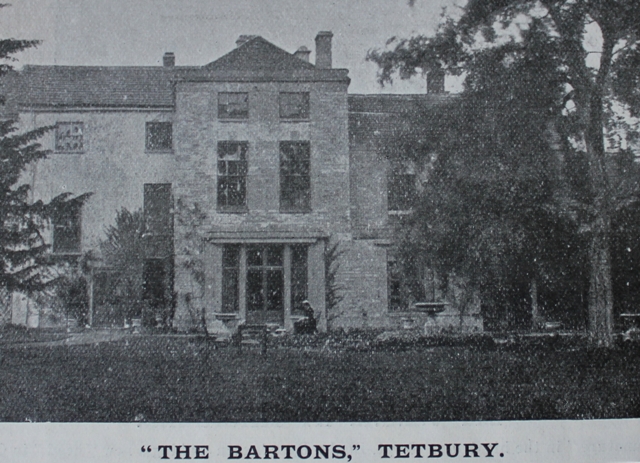 1878 Mr George John Whyte-Melville, author and ballard writer died in a hunting accident and was buried in the churchyard in December of that year. A controversial request to disinter the body was made by his widow, Charlotte, in 1904 who wanted him reburying in her now home county of Suffolk. After objections by his daughter this request was abandoned. In 1888 Charlotte Higginson Whyte-Melville sued for a declaration of the nullity of her marriage with the Rev.Henry P.Higginson, on the ground that he was already married (in 1862). He had been Charlotte's private chaplain at her residence, The Bartons, Tetbury, at £600 per year and she went to Geneva with him to be married in 1886. Her 'husband' had been an officer in the customs at Dublin, went into several businesses, and was ordained in South Africa in 1877. The decree was granted.
1886 William Brookes, The Bartons
1896 - 1935 Charles Willoughby BISHOP late Major 9th Lancers
In 1924 Mrs Bishop was advertising throughout June and July for an experienced parlour maid 'two in family and 5 maid servants; state age and wages required'.
July 1913 a fire at Barton Abbots had cost £1 8s 9d the captain of the Tetbury Fire Brigade (Mr Warne) reported to the Urban Council
In 1899 Major Bishop was calling for men to serve in South Africa. His address was given as Barton House.
Caradon
56 Cirencester Road
C18th with later additions
Coombe House is mid C18 and situated at 3 New Church Street.
It was converted into flats and a learning centre in 2002/3
From the Wilts & Gloucestershire Standard, first published Tuesday 7th Oct 2003.
OLD Coombe House in Tetbury has been given a new lease of life.
The historic building, in new Church Street, has been turned into a centre of learning and seven affordable homes. Dignitaries were invited to see the transformation at an official opening on Friday. Fosseway Housing Association organised the refurbishment and restoration of the derelict building. Its original features have been retained, beams are exposed and it has natural stone walls. District councillor Sue Jepson said: "This is a valuable mixed-use project to help the young people of Tetbury with affordable housing and opportunity for training. "I'm particularly pleased that four flats are for single people under the age of 25."
Cirencester College is operating the centre, called @Tetbury, and a variety of courses are on offer, including IT, craft and family issues. One local already taking advantage of the new facilities is town mayor Marlene Ash. She said: "I'm doing an ECDL which stands for European Computer Driving License. "It's the sort of qualification that they ask for now if you are starting work . "I'm retired but I'm doing it to learn more about computers because my grandchildren can already use them. I'm really enjoying it. I wouldn't have been able to do this course if it had been in Cirencester."
Funds for the project came from Fosseway Housing Association, Cirencester College, Cotswold District Council, the Learning Skills Council, the South West Regional Development Agency and Tetbury Town Council.
| 1887-1902 | George William Wetton Ashdown M.D, C.M. Edin, M.R.C. Eng, Surgeon |
1903-1930 | John Stafford Mellish M.R.C.S Eng, L.R.C.P Lond surgeon medical officer & public vaccinator Didmarton district, Tetbury union & joint hon medical officer Cottage Hospital Coombe House |
| 1911 | census stated that house had 13 rooms |
1922-1943 | Dr Sedgwick (records seem to cross over the dates of Mellish and Sedgwick according to resources used) |
| 1998 | Conversion of two bedsits into one at 26 and 27 Coombe House, New Church Street Gloucestershire Archvies: ref.Cotswold District Council, Building Control Department, DC111/118 |
| 2002 | Tetbury will soon have its own learning resource centre thanks to a £97,000 grant from the South West Regional Development Agency. The money will be used to convert a disused garage which adjoins Coombe House into a flexible learning space with 15 PCs, a reception area and meeting rooms. Wilts & Gloucs Standard 12/8/2002 |
Delburn House
Gumstool Hill
Situated on the west side of Gumstool Hill, has a distinguished left part built in 1741, ashlar faced, of two storeys plus attic, with heavy modillion cornice. Windows with moulded architraves, those on the ground floor with pulvinated friezes and dentil entablatures. The door hood in the plainer right wing is supported by one splendid acanthus carved bracket.
Verey, David; Gloucestershire. - 1 : The Cotswolds; 3rd ed; London : Penguin, 1999; 0140710981
Five Trees
Folly House
Chavenage Lane
The Grange
1538 The Crown leased property called Ilbury otherwise the New Grange to Sir Nicholas Poyntz, formerly the property of the dissolved Abbey of Kingswood.
Hockaday Abstracts Tetbury vol.1
The Grey House
Hampton Street
the late Miss Jane Golightly, owner, the estate now being wound up was advertised to be sold by auction on 26th March 1952, auctioneers Tuckett & Son, Tetbury, freehold estate consisting of lounge hall, 3 reception rooms, garden room, 7 bed and dressing rooms, bathroom, domestic offices, cellar and a good garden. It was also described as a substantial stone built Cotswold house with stucco finish and stone tiled roof.
Hatfield Cottage
20 Bath Road
The Limes
Bath Road
1878-1928 William Warner. Mr Warner was a noted breeder of cattle at Wesley Farm, and associated with the Tetbury Board of Guardians, the Rural Council and Tetbury Upton Parish Council. He spent over 30 years as a churchwarden at Beverston, which is where he was buried on his death in June 1928 aged 80.
Cheltenham Chronicle - Saturday 16 June 1928 page 12 col.b
Malthouse Cottage
a lovely old building hiding a multitude of uses. I was privileged to be shown around as part of a tour organised by BGAS and hosted by HOTS. I particularly liked the old passageway through, you could feel the age in the stonework and woodwork.
The Chippings
Northland Cottage
London Road
The name Norteland was in use in 1560.
Northland Cottage is situated on the main London Road out of Tetbury. In 1841 it was called Northland Lodge and was inhabited by an agricultural labourer Thomas Still and his family.
By 1851 John Large, another agricultural labourer was living there with his family.
In 1861 there are two households there, with the name changed to cottage - had the original lodge been converted into two homesteads? John Large in one, and a widow, Charlotte Timings in the other, with her sisters Eloise (or Eliza?), Frances and sister in law, Harriet. The Large family were in possession of a cottage, and Mrs Timings a house, garden and land. The landlord was John Cook snr.
John Large was still at the cottage in 1881.
Charlottes' father lived in Charlton Kings, which is where she and her sisters lived in 1851. By 1881 she and Frances were living in lodgings in Cheltenham and they both died there in 1886 (Frances aged 90) and 1891 (Charlotte aged 87).
1897 Aubrey Paul Kitcat - an apple named Northland Seedling was raised by AP Kitcat, Northland Cottage, Tetbury around 1930.
Oak House
The Chipping
C18th
Oakhill
2 Northfield Road
for sale following death of owner, Mr A E Osborne
advert 17 April 1948
auction Weds 21 April at Talbot Hotel
The Old Coach House
Bath Road
built around 1870 alongside the large family house next door, both to take advantage of the forthcoming railway line to the Bath Road that never materialised.
The Old Toll House
6 Bath Road
This cottage apparently built c1750-60 but the architectural character appears to be rather later. The road was turnpiked in 1743 but the new bridge built in 1775 must have made the use of this cottage rather difficult and it was superceded in 1821. It is unusual to have two toll houses surviving so close to each other but local rumour says that to avoid the tolls people were cutting through what is now Berrells Road and down Cutwell. The new toll house was built opposite this turning so hoping that the toll avoiders would be caught and duly charged!
Oldham House
14-16 New Church Street
c.1750
Overdale
18 The Chipping
An end of terrace house situated in The Chipping, which is a delightful square of mainly 18th Century houses within a short, level walk of the town centre. Overdale has a classically beautiful façade with sash windows and an attractive radial fanlight above the door.
C18th
The Priory
Chipping
A note in the parish register 1631-1798 states that Mr Sloper's house was built 1766-1767 with The Priory pencilled in next to this.
Porch House
Long Street
Pump House
The Green
C18th
| 1842 | Deborah Smith, lately of London was living in The Retreat |
| 1851 | John Gale Goodwyn, bookseller, printer & stationer living there with his family and three servants. |
| 1861-1901 | John Gale Goodwyn was still employing three servants. He died in 1876 leaving his widow, Maria in the house with the family. She died in 1891. Son John who was living there in 1891 died in 1893. |
| 1892 | Sales Particulars from Mullings, Ellett and Company, Cirencester, solicitors had The Retreat Estate, with plan of Highgrove Estate Gloucestershire Archives ref. D1388/SL/7/61 |
| 1901 | Elizabeth Selman Fowler, widow of John Fowler of Cranham Farm, was the head and had sister Mary Pope Fowler, sister in law Mary Eliza Fowler, widow of a farmer, Samuel Selman Fowler, along with one of Mary Eliza's sons and her youngest daughter. They were all living on their own means. |
| 1910 | At the time of the Land Valuation Survey Miss Mary Pope Fowler [sister in law of Mary Eliza above] of Grange Farm was the owner and it was rented by Matthias John Baker Driver who paid £40 per year. His tenancy began in March 1909. |
| 1919 | Bruton, Knowles and Co, Gloucester, estate agents, auctioneers and valuers - date: 1892, 1919 The Retreat, Tetbury, Sales Particulars Gloucestershire Archives ref. D2299/1803 |
| 2007 | planning permission sought for demolition of care home and the construction of 19 two and three bed two-storey houses and associated road works |
The Retreat
In 1910 the property was described as a brick built stucco and slated house buildings and lands. The house contained three reception rooms, kitchen, scullery, larder, pantry with five bedrooms, one attic and two lumber rooms. There were two WC's, one inside and one outside which was disused. Water supply was satisfactory. In the yard there was a washhouse with boiler, stone built and stone tiled stabling, two stall coach house with loft over. There were two garden buildings, a small greenhouse, woodshed, walled inkitchen garden, lawn and flower garden. It was of a fair structural repair but poor decorative condition.
The house and grounds eventually passed into the hands of the Fosseway Housing Association but in 2007 the modern care home addition was empty and looking very scruffy. Plans are sited with Cotswold District Council for a new development on the site.
Tina Robins wrote the following report in the Wiltshire & Gloucestershire Standard in November 2006:
"New social centre possibility for Tetbury
A NEW social centre for the elderly could be on the cards for Tetbury as a result of Fosseway Housing Association's decision to turf users out of the Retreat.
Town councillors, disgusted by the organisation's action, are to look at creating a new "community campus" for the town at the Dolphins Hall.
Fosseway wants to develop the Retreat as social housing and has moved elderly tenants out over the past months.
But users of the day centre thought they had until Christmas to find new meeting places, until last week when they were suddenly told they had to go after the association was told its insurance company would o longer provide cover. Mayor Stephen Hirst said: "While they had known for some time the building was going to be vacated, when the crunch came they were given seven days to quit, which is ridiculous."
Another base had been sought, but the only viable alternative was to use the St Mary's day centre on Wednesdays and Fridays if the Probus Two group agreed to change its Wednesday meetings.
He said the council contacted the housing association some time ago offering to take over St Mary's, which housed a meeting room downstairs and a vacant flat upstairs.
"They have agreed to seriously consider letting us lease the bottom of the building and keep the flat for themselves," he told colleagues on Monday.
The flat would be sealed off and disabled toilets installed in the centre. They would also look at changing the layout of the ground floor.
Cllr Tony Walsh said: "Fosseway should be shot. They have said time and time again that they were not going to sell the Retreat. They were not going to redevelop it without approaching us."
He said several years ago the council had looked at the possibility of extending the Dolphins Hall. He suggested approaching the hall's management committee and reviving the idea. "We can raise the money."
Also unhappy with Fosseway's decision Cllr John Dearnley said: "We found out by accident." It was only with a major effort by the mayor that a disastrous situation had been retrieved.
Cllr Peter Martin agreed. "This is a disgrace," he stated. "This is a final wake up call for us. We cannot rely on these people to make social provision for this town.
"We should be looking at finding a property where we can have a centre for the elderly that the town owns and has control over.
"The Dolphins Hall site could be a new community campus. It could even provide a new home for the town council.""
15/11/2006
Sundial House
The Green
1661
Tithe Cottage
The Green
Tollgate Cottage
Hampton Street
A natural Cotswold stone detached cottage under a stone tiled roof. The original part of the cottage was believed to have been built around 1860. There is a large extension to the side giving generous living accommodation. The cottage has a wealth of character features such as beams, leaded windows and window seats and a large stone fireplace and hearth.
c.1860